Cosmography

“Cosmography” sounds like the kind of thing a pair of fantasy authors would make up, but it’s absolutely real.

When Alyc and I first came up with the concept for the Sea Beyond duology, our pitch to our editor handwaved something about a “Guild of Cartographers” being the ones behind the mapping and colonization of the Sea Beyond. Early in our research, though, Alyc — looking for resources on the cartography of the era — came across a book that had a profound effect on our plans: María M. Portuondo’s Secret Science: Spanish Cosmography and the New World.

Nowadays you might hear the term “cosmography” in the context of astrophysics. There, it has to do with very large-scale studies of the observable universe; naturally this is not what we mean when we use the term, nor what Portuondo is describing in her book. Cosmography in the older sense of the word is an idea that predates modern intellectual specialization — something we’d call “interdisciplinary” now. Its aim was nothing less than the holistic description of . . . basically everything? (Kosmos, of course, being the Greek word for the world or the universe.)

Cosmography included cartography, but it didn’t stop there. It began with geography, describing where things were, how big they were, and so forth, and hydrography, describing the coast, the rivers and ports, how to sail from where you were to where that place is. Cartography then played a role in pinning those things down, using math to represent them accurately on a two-dimensional surface. But the physical side was only the first half of the equation, because cosmography also included historical chronicles, ethnographic descriptions, and inventories of natural resources. If it was worth knowing about a place, then cosmography included it.

This was both an intellectual and a political undertaking. Intellectually, it was an outgrowth of the old belief that it was possible to sum up the entirety of the world in one magisterial work. Politically, it was a very useful tool, because you can’t govern what you can’t find or don’t know about. For us, there’s also a mystical dimension: the idea that to know a thing, to be able to represent it in another form, is to gain control over it in less tangible ways.

And as Estevan studies cosmography, he sees the ways in which this isn’t entirely a negative undertaking. After all, human curiosity is a grand thing, without which we’d all live much poorer and less pleasant lives. He himself is fascinated to learn — including about humans, absorbing information on their customs and culture in much the same way that the king’s cosmographers do about the islands they’re conquering. The difference is the use to which it’s put.

Along with who gets to use it. One really fascinating thing in Portuondo’s book is the shift that happened between the reigns of Philip II and Philip III. Under the rule of the former, cosmography was the titular secret science. Information on the New World was meant to be closely controlled, with the official map being kept inside an ark with three keys. (This map was also supposed to be regularly updated. Turns out that . . . really didn’t happen.) One demonstrated one’s political power by keeping things hidden. But when Philip III took the throne, both changing circumstances and his own temperament led to a massive shift; the official map, far from being locked up, was published. Now the growing colonial powers of Europe demonstrated their power by showing how great their cosmographic understanding was!

But also, cosmography was on the way out, at least under that name and formulation. The influx of information from the New World had gone from a trickle to a firehose, and it proved absolutely impossible for one person to keep up with it, let alone to write the kind of all-encompassing book that could explain the entire world. That world had gotten too large, too complicated, and the component disciplines of cosmography had advanced too far to cram them all under a single umbrella anymore. We still do all the things cosmographers did; it’s just that now, geography and hydrology and anthropology and history and so forth are separate disciplines, cooperating here and there, but no longer seen as facets of one particular thing.

At the moment of the novel, though, the idea is still hanging on. And it means that, like us, Estevan goes from thinking he needs to know about maps to realizing that cosmography is the key to . . . well, everything.
Writing religion

If you think there’s a lot of religion in The Eye of Leviathan, you’re not wrong . . . but also, there’s probably not nearly as much of it as there should be, historically speaking.

It’s difficult for me and Alyc to accurately represent just how pervasive religion was back then. And not just in Spain, or in Catholic countries more generally; this was true of Protestant ones too! Religion used to saturate everything in a way that’s tough for the two of us to truly imagine, because our own lives are very different. Alyc was raised a very half-hearted Catholic; I was raised a very half-hearted Methodist. Even if both of us had more active faith, though, we don’t live in the kind of society where Christianity influences everything from the calendar to the books we read. We do our best to note festivals and holidays where they ought to be occurring, but we have to remind ourselves to do that. Estevan thinks a few times about specific Bible verses, in places where we happened to know of something relevant, but it’s hard for us to summon those on demand; we simply don’t have the bone-deep familiarity that would let us make those references without putting in an extra layer of effort.

This topic gets especially thorny when we reach the points where modern mentalities and the historical incarnation of Catholicism tend to part ways. Without going into spoilery detail, there’s one character appearing in a few scenes whose attitude and rhetoric are straight-up inspired by St. Teresa of Ávila . . . and, as I said to Alyc at the time, “I’m probably getting this about twenty percent of the way to where it should be, and for some of our readers, that will still be too much.” The embrace — the valorization — of suffering as a holy act exists just a quarter-step to the side from some really thorny issues of mental health and even abuse. How do you represent that honestly, in a way that communicates what it meant to the people of that era instead of what we read out of it now?

At the same time . . . for all that Spain circa 1600 was rampantly religious, that doesn’t mean it was perfectly so. In fact, devout and pervasive faith existed right alongside people who rarely went to Mass, who couldn’t recite their prayers correctly, who were prone to saying things like “fornication isn’t a sin, right?” and “the Virgin Mary was a true pope, the equal of St. Peter.” Half the purpose of the the Council of Trent was to fix the absolutely dire state of orthodoxy among the common people. Just as we’d be misrepresenting the Inquisition if we depicted it as all-powerful, we’d be misrepresenting early modern Spaniards if we wrote them as being flawless Catholics.

When it comes to questions of representation, often the answer is to give more than one answer. A single depiction looks authoritative; once you have several, they can differ from each other, and that difference opens up space for interpretation. Obviously the conflict between the Church and the fae casts the former in a bad light — but we’re not out to say anything half so simple as “Catholicism bad.” So right there in the prologue (this is not a spoiler), you get Teresa praying to the Virgin and then making a deal with a faerie to protect her child. She can be a faithful Catholic without necessarily being an orthodox one; she can do things the Inquisition would punish her for without it meaning she isn’t sincere in her belief. Religion is a comfort to Teresa, even when she knows it’s a terror to her immortal friend.

People are messy like that. And sometimes, so is religion.

Everybody expects the Spanish Inquisition

With the release of The Eye of Leviathan, we’re finally free to talk a bit more about what’s in the book!

. . . starting with the Inquisition.

We had a delicate path to walk here. On the one hand, the Inquisition features heavily in what’s called the “Black Legend,” a set of negative stereotypes about Spain in this era that continue to affect perceptions to this day. On the other hand, writing about Spain in this era and not accounting for the Inquisition would be a bit like writing about modern U.S. politics and not accounting for the influence of evangelical Christianity. Given that a tension between faerie things and Christianity is also baked into European lore, the notion that the Inquisition wouldn’t take a dangerous interest in our Otherworld and its peoples was implausible.

But the Inquisition isn’t quite what popular imagination makes it out to be. Ask the average person and they’ll probably say something about witch-burning; in reality, the Spanish Inquisition was founded to examine and enforce the religious orthodoxy of Jews who had converted to Christianity. Soon after that, all Jews in Spain were required to either convert or leave, at which point the Holy Office began doing huge business hunting down crypto-Jews. When a similar thing happened to the Moors later on, they also started looking for crypto-Muslims — and between and around those things, they also dealt with anything else considered a religious crime: heresy (which included Protestantism), sodomy, bigamy, blasphemy, and so forth.

What about faerie stuff? Our premise for the book assumes that Spain is readily acquiring and using magic from the Sea Beyond, so unless we handwaved the Inquisition offstage entirely, we couldn’t say their mandate was to quash those things. Instead, they police improper trafficking in faerie matters: acquiring, selling, or using magic you’re not supposed to have is a religious crime. (Which, naturally, means those things mostly accrue to the wealthy and powerful, who have more legal right to them than the average peasant.)

As for what they do when they find infractions . . . One of the big stereotypes of the Inquisition has to do with torture. But this is another place where the Black Legend rears its head, because the truth is, every law enforcement body in Europe back then engaged in torture. It wasn’t specifically a Spanish thing, or a Catholic thing, whatever Protestant propaganda in countries like England might have you believe. And while the Inquisition used that tool like everybody else, they had strict rules around its deployment; you might genuinely be tortured less by the Holy Office than by a secular authority.

What does distinguish the Inquisition in a sinister way is its pervasive secrecy. Nobody was allowed to talk about their processes (though of course word did leak out, and they kept extensive records of their own work, which is how we know anything now). If you were arrested, you weren’t told what you’d been arrested for; instead you were invited to confess everything you’d done wrong — with, of course, consequences if you didn’t admit whatever wrongdoing they’d already decided you were guilty of. You could get testimony against you stricken from the record if you could establish that the person who gave it had a grudge against you and might not be acting in good faith . . . but you weren’t allowed to know who the testimony was from, so good luck with that. There was no appeals process. Your defense lawyer was there to guide you in your confession, not to actually defend you. If they arrested you, they’d already decided you were guilty; everything after that was to establish just what you were guilty of, and what should be done about it.

And of course, as with any censorship regime, the goal was less to actively suppress everything unwanted — which takes a level of effort and resources the Holy Office never actually had, because no censorship regime ever does — and more to frighten people into suppressing themselves. To do nothing that might draw inquisitorial attention, or if you did it, to turn yourself in and confess so you could be let off with a lighter sentence. To denounce your neighbors if you saw them doing anything wrong, because seeing and not saying anything might itself be considered a crime.

Yet despite all that, this was also an organization run by people, with all the flaws that implies. In our research, we turned up gobsmacking stories about the Inquisition just acting like flagrant bullies, including breaking the law. In Valencia this technically had subsided by our period, but given the alternate nature of our history, we decided to let their bad behavior continue onward. So on the one hand you have the Holy Office as this sinister, secretive force . . . and on the other hand, you have them smuggling faerie contraband so they can profit on the side, and inquisitors getting into brawls with bishops over who occupies the best seat at a parade.

In short, our goal is be as even-handed as we can. Of course our changeling protagonist needs to be afraid of the Inquisition, but we want him to be afraid of the right things, not the stereotypes. And we want to counterbalance that with the moments when the Inquisition stops looking like this terrifying monolith and starts looking like a bunch of corrupt, arrogant guys, not much different from anybody else with power.

Because in the end, it’s power that’s the threat — not this one specific, famous instance of it.

Two Sea Beyond teas from Dryad!

We are delighted to announce that we have once again paired up with Rubiee at Dryad Tea to create book-themed custom blends, just as we did for the Rook and Rose trilogy! Choose your flavor, and click the links below to order . . .

  • Leviathan’s Tears — In the waters of the sea beast Leviathan, wonders can be hidden inside a nut’s shell. A medley of nut flavors gild the revitalizing energy of black tea.
  • Behemoth’s Blood — Lush cherries and sweet almonds over a black tea base evoke the bounty of the mortal world, the realm of the great bull Behemoth.

(Non-U.S. customers, you can contact Dryad Tea on Etsy to inquire about ordering these blends.)

The Eye of Leviathan is out now!

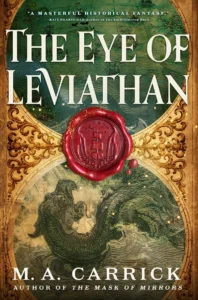
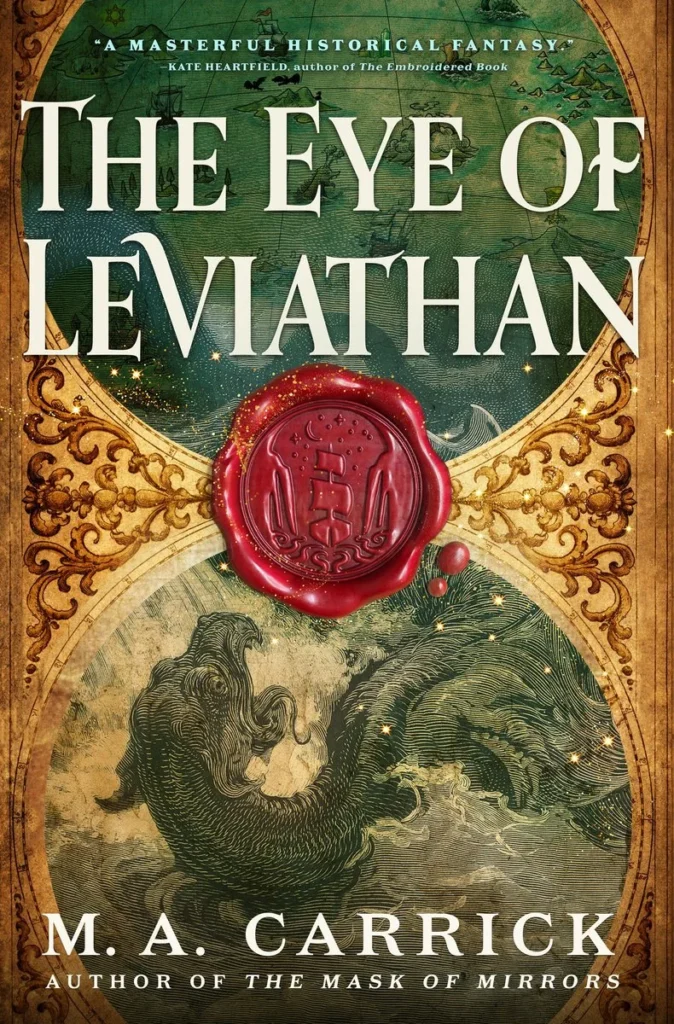
cover art for The Eye of Leviathan by M.A. Carrick, showing a half-circle of a green-tinged map of the Otherworld above a half-circle of an engraving of a sea beast. The intervening space is filled with gold filigree, and joined by a blood-red wax seal with a ship sailing between tall cliffs toward a starry sky, with tentacles in the waves below.The time has finally come to set sail for the Sea Beyond! Journey with us through the Pillars of Hercules to an Otherworldly ocean full of islands out of myth . . .
In an alternate Spanish Golden Age, where the map becomes the territory and mapmakers are the architects of reality, the Council of the Sea Beyond has risen to unrivaled power, exploiting the world’s most precious resources for their own gain.

Determined to discover how cosmographers pin down the islands of the Otherworld, Estevan seeks power with the Council of the Sea Beyond – but he risks the exposure of his own secrets, too. For he is a changeling, a faerie masquerading as a mortal. And for a faerie to enter the mortal world like that, a child must go the other way . . .

The Hungry Girl, the nameless human daughter whose place he took, has grown up opposite her “brother.” Lost among the fae and desperate to find some purpose for her existence, she leaps at the chance to help a group of Spanish explorers in the Sea Beyond . . . only to be horrified at the atrocities they commit.

Soon the unlikely siblings will need to overcome their rivalry — because only together can they bring down Spain’s worlds-spanning empire and save the homes they have come to love.

You can order the paperback, ebook, or audiobook from your retailer of choice right here!

“Non Plus Ultra”

We are just over one month from the release of The Eye of Leviathan, and we have something to whet your appetite/tide you over until then! Adventitious has just published “Non Plus Ultra,” a prequel novelette that tells the tale of how a sailor from Valencia discovered the secret of passage to the Sea Beyond. Join us on a voyage into Otherworldly waters, full of lost princesses, Goblin Markets, and “that’s no island” . . . It’s free to read online!

Last days of a Kickstarter!

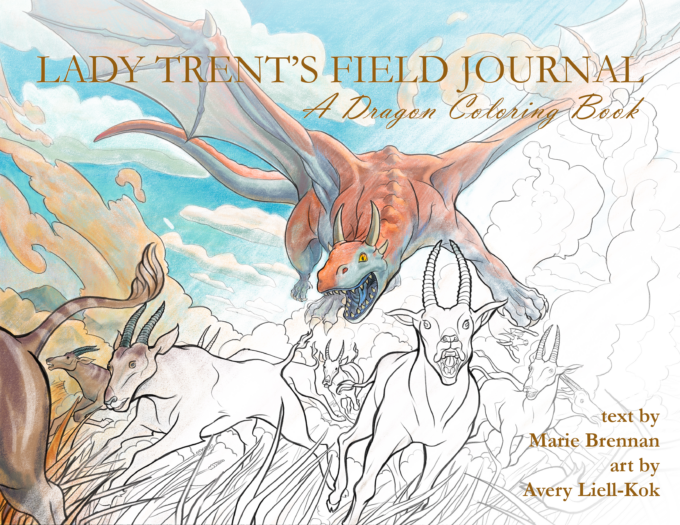
This is not an M.A. Carrick project, but since it involves me and one of artists from the Rook and Rose pattern deck, I’ll give it a quick plug anyway! Lady Trent’s Field Journal: A Dragon Coloring Book is (as the name suggests) related to my series The Memoirs of Lady Trent — but thanks to stretch goals unlocked, it’s more than just a coloring book! A quick rundown on what’s on offer there:

  • a coloring book with ten dragons (some of them new to this book), accompanied by excerpts from Lady Trent’s scientific writings — available in digital, loose leaf, and paperback formats
  • an “artbook” version of the above, fully colored in by the artist, Avery Liell-Kok — ditto those formats
  • Volume II! — ditto re: both formats and the choice of coloring book or artbook versions
  • signed special editions with a quick bonus sketch from Avery — limited numbers
  • signed paperbacks of the novels in the series
  • signed bookplates

Some things will still be available for late pledges after the campaign ends, but not the signed editions (of which there are only a handful left anyway) or novels. So if you’re interested, the campaign is in its final days — get in while the getting is good!

Cover for The Eye of Leviathan!

We are behindhand in posting this here, but we have cover art for The Eye of Leviathan!

cover art for The Eye of Leviathan by M.A. Carrick, showing a half-circle of a green-tinged map of the Otherworld above a half-circle of an engraving of a sea beast. The intervening space is filled with gold filigree, and joined by a blood-red wax seal with a ship sailing between tall cliffs toward a starry sky, with tentacles in the waves below.

This is very much a collaborative effort: the sea beast at the bottom is from The Destruction of Leviathan by Gustav Doré, the map at the top is drawn for our series by Tim Paul (who also did the map for the Rook and Rose trilogy!), the seal at the center was designed by inkshark (who also did the Rook and Rose logo!), and then the whole thing with its frame was designed and composited together by Lauren Panepinto and Lisa Marie Pompilio.

And we also have our first review, up on Netgalley! “A rich, tense, and engrossing historical fiction-fantasy […] The meld of historical fiction, Greek mythology, Fae mythology, and political fantasy was exquisite” — yeah, we’ll happily take a five-star review like that. 😀 Counting down the days until the book is out . . .

The (first) decks have arrived!!!

If you haven’t seen me Kermit flailing all over social media already — our expedited set of pattern decks have arrived!

a photo of a pattern deck in its box, showing Emiko Ogasawara's back design of a spindle, shuttle, and shears joined by violet threads and ribbons

a photo of the pattern cards spread out so you can see Hundred Lanterns Rise, The Face of Stars, and Turtle in Her Shell

The bulk of our order is coming by sea mail, so they won’t be here until late July at the earliest. But we wanted to have some to show off at BayCon, where we will be among the Guests of Honor next weekend! If you’re a Kickstarter backer who ordered a non-gilt-edged deck, let us know and we can probably hand-deliver yours to you at the con.

They are so pretty, y’all. I was nervous because we’ve never produced a deck before, so many elements of the process were new to us, which always introduces the chance to misunderstand and screw something up. But no: they look exactly as gorgeous as we’d hoped, and super professional. This is absolutely a deck we can be proud of. And if you want one but missed out on the Kickstarter, we’re still selling them on BackerKit!

Back to petting my deck and trying not to behave too much like Gollum . . .